
Figure 4: Hydrocephalus in male rat (Chase)
Case history and photos
History
Chase was born March 13 2003 to a litter of 13, of which 3 were born with hydrocephaly. One was born with a mild form of the condition, one in which the condition was considered moderate, and Chase who was considered to have a more severe form of the condition. His growth is stunted, and he is about 1/2 the size of his normal male siblings. The other babies with mild and moderate hydrocephaly are about 1/2 size also. He also shows obvious impaired mental capacity, as do the other siblings with mild and moderate hydrocephaly.
Chase has not been neutered, and shows normally developed testicles. However, he has never showed any sexual maturity around unspayed females. The siblings with moderate and mild hydrocephaly have showed some sexual maturity and have displayed interest in the unspayed females, but have lacked the ability to impregnate any of the females. The question that arises, is, are they able to reproduce?
Clinical Signs
February 16, 2004 at 5:30pm Chase started to have a series of 3 rather violent seizures. The following describes the type of seizure activity seen:
- Raises on his hind legs, sniffing hard.
- Eyes glaze over.
- Bats at the air in front of him with his paws.
- Falls over flailing violently.
- Tongue hangs out of mouth.
- Muscles stiffen.
After the seizure Chase was hypersensitive to touch for one minute, and after 2 minutes his posture appeared normal, although somewhat lethargic. He was rushed to the vet immediately where he was given 2.5mg/kg of Valium to stop further seizure activity. The medication kept him sedated for several hours.
Diagnosis
Seizures resulting from possible increase of intracranial pressure secondary to hydrocephaly.
Treatment
February 17
Chase experienced another seizure at 5:30pm, and was once more rushed to the vet. While at the vets office Chase had another seizure and was promptly given Valium 1.5 mg/kg to halt the seizure activity. The dosage given was less this time in an effort to reduce the length of sedation time.
In retrospect, I believe the seizures may have started about a month before Feb. 16, though they were not actually witnessed. I had noticed strewn litter out of the cages, but just attributed it to regular rat activity. But, when I witnessed the seizures, litter was strewn in the same manner as I had seen previously.
February 18
We started Chase on phenobarbital 0.2ml BID (twice a day), based on 2mg/kg.
March 11
Chase had one seizure at 11pm. The vet was called the next morning and and the dosage increased to 2.2 mg/kg BID (twice a day).
April 12, at 5:45 pm
Yet another seizure was witnessed. The vet was called the next day where he recommended the dosage again be increased to 2.4 mg/kg BID.
April 25, at 9:30pm
Chase had another seizure, and a call was placed to the vet the next morning. The vet stated that at this time he didn’t want to increase the dosage of phenobarbital unless additional seizures were witnessed.
May 6, at 5:30pm
There were 3 successive seizures, and a call was placed to the vet. Based on the additional seizure activity he said to increase the dose of phenobarbital to 2.6 mg/kg BID, but indicated he was concerned about Chase’s heart and requested he be brought in for a check up. We scheduled the appointment for May 11. On exam of Chase the vet said his heart was fine, and recommended we increase the dosage of phenobarbital to 2.8 mg/kg BID.
May 20, at 7pm
There were 3 successive seizures. I called the vet and was told to again increase the dosage to 3.5 mg/kg BID. The vet stated that if the seizure activity continued to give him an extra 0.5 mg.
June 2nd, at 8pm
There was one seizure. An extra 0.5 mg was given with Chase’s evening dose, so that he received 4.0 mg/kg. The following day on June 3, at 8am, there was another seizure, and again he was given the 4.0 mg/kg for his morning dose.
Thereafter I resumed his 3.5 mg/kg dosage until on July 8, at 7pm, he had two successive seizures. At this point I noticed the seizures looked like they were taking a physical toll on Chase. It was decided at that point to increase his dose to 4 mg/kg which is the upper limit of what we determined was the therapeutic range of 2-4mg/kg BID of phenobarbital. After contacting the vet to let him know the dose Chase was now receiving, he said not to give him more than 4 mg/kg BID, after I explained that Chase was lethargic and drowsy most of the day on that dose.
Outcome
As of the end of July, Chase’s seizures appear to be controlled, although he is somewhat lethargic on the 4 mg/kg BID. He weighs in at 400 gms. If the seizures had continued, or should his condition deteriorate the only course would be euthanasia. The vet stated that Chase’s problem is not biochemical but mechanical, and that there is only so much that phenobarbital can do to control the effects of the hydrocephaly.
Follow-up
Chase experienced two major seizures, this morning, Aug 16. He had one seizure prior to his morning phenobarbital dose, and then again following the dose. We are continuing to monitor him closely.
Photos
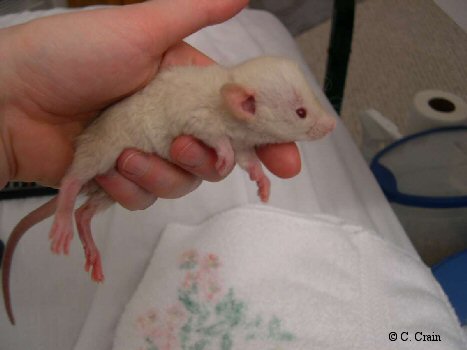 Photo 1: Chase at 3 weeks of age. |
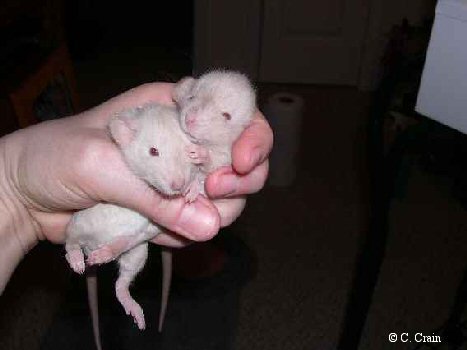 Photo 2: Chase at 3 weeks along side of sibling. Note size comparison of both body and head. |
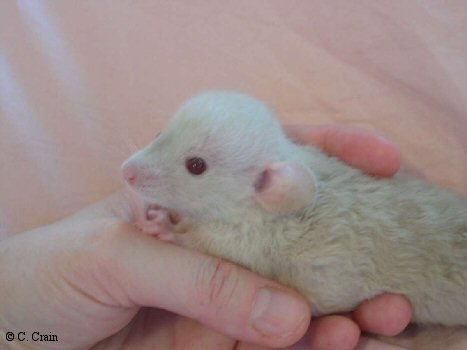 Photo 3: Chase at 1 month of age. |
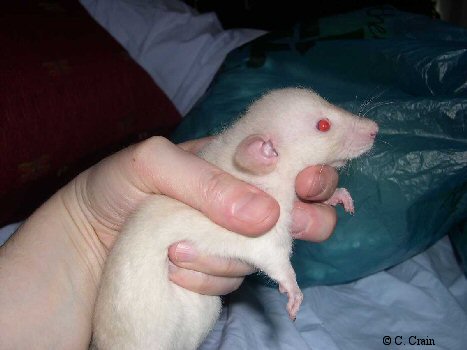 Photo 4: Chase at 6 weeks of age. |
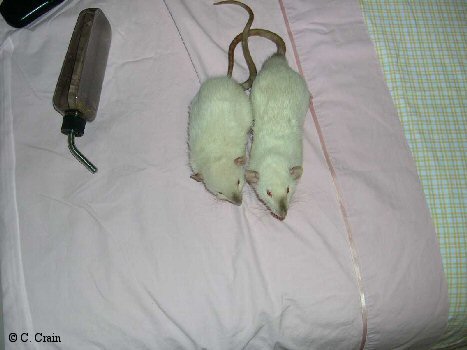 Photo 5: Sibling comparison at 14 weeks. |
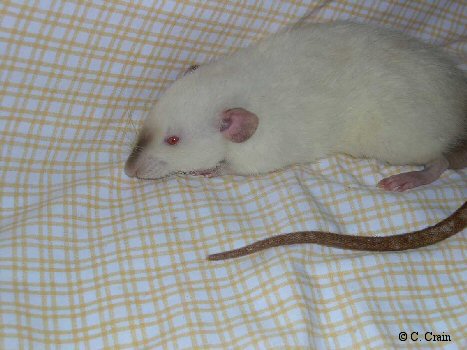 Photo 6: Chase at 9 months of age. |
Case history and photos courtesy of Charlene M. Crain, MBA, BSMT (ASCP) and
Dr. Greg Rich, DVM, at West Esplanade Veterinary Hospital

